|
|||||
|
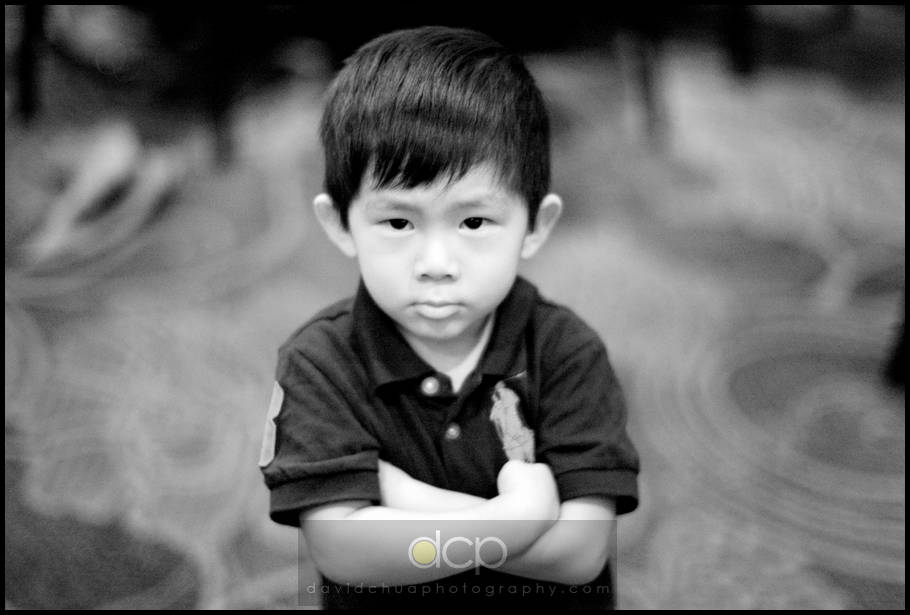
Wedding Photojournalism is to capture un-posed moments in an unobtrusive style. By now, “everyone” seem to be doing it… as digital seems so easy… without the stress of wasting films. It has also become a lot more sloppy in the industry. This started in the early 1990s, when black and white films were being used due to the need for high speed ASA1600-3200. As there were (and still is if not worse…) limited choice of high speed film available in the market, wedding photojournalists had to shoot black and white, as choices were limited to either the Fuji Neopan 1600 or the Ilford Delta 3200. Of course, some chose to push process ASA400 B&W films… The color film choice would be the Fuji Superia 1600 but it seemed that grains in color film were NOT as widely accepted as grains in black and white films so wedding photojournalism ended up mostly black and white. Just yesterday, I received news from a friend’s email that Fuji is discontinuing it’s Neopan1600 film. I find this totally idiotic when in recent years, there has been a significant resurgence of film users! And Kodak has just developed 2 NEW films for us over the last 2 years! (though they also discontinued the Kodachrome) It’s sad news to me and to many B&W film users… Oh yeah.. she’s no longer a baby. She’s 3 this year. I have been a photographer for this family for years and it all started with her parents’ wedding years ago. Pics of her birthday party last year is HERE. Here are the some of my favourite pictures this year. For all those who are interested to hire me as your photographer and wish to view full sets of portfolio, it’s all available. Just contact me via phone or emailĀ ![]() Man smoking, waiting. Olympus E-P1 at 14mm, 16:9 format, built-in art filter. I was about 2 metres from my subject. I have recently grown much in love with small cameras like the Olympus E-P1, Leica M6, Rollei 35mini, and even the old classic legendary half-frame Olympus PEN FT, just to name some. My madness and fanaticism over small cameras is not getting any better and in fact, is getting worse… though the Leica M9 at RM25k is way out of reach. I figured that I can do the same thing by mounting my Leica lenses on my Olympus E-P1 via an adaptor and manual focus it even better than the M9 by using live view. Haha… self-consolation maybe. Or use my full-frame film Leica M6. Cheers man! Still, I am often humbled by the fact that good images do not rely on good cameras BUT good photographers! Just browse through Flickr and you will be humbled just like me. Many of my favourite shots often come from my small compact cameras too. Why own a perfect, what I call a “magic camera” like the Nikon D700 or D3, that when you wanna “steal a shot”, the cameras are so huge that you will be caught way before you press your shutter button! Not unless you are using a 70-200mm telephoto or even longer, and stand 50 -100 feet away. However, I also remember Robert Capa said,” If your pictures aren’t good enough, you aren’t close enough.“ So, I guess wide angles and standards are still my preferred choices. I like to sneak up close and personal, “steal” a shot without scaring my subjects with huge cameras, and sometimes, “ask” for a shot from my subjects. (I’ll be writing on the difference between “stealing” and “asking” for shots in another post). So, why do I call the D700 a “magic camera”? Cause it really can continue shooting at ISO6400 or higher when all other cameras “died” in the darkest environment ever. (Of course the Canon 5Dmark2 too will continue shooting, but maybe focus blur. Kidding… cause personally I think Nikon’s AF is better). Then the Olympus shooters will exclaim, “why shoot in such lowlight when the lighting is not even good, all flat?” And the Olympus shooters will whip out their off-camera TTL flash and boasts of the best skin tones and lighting achievable in such situations! No doubt, they will get the best-looking portraits. I often wonder, why still shoot when all around you is so blindly dark??? Oh, then I figured that maybe you are a paparazzi or a private investigator doing your job trying to catch someone in their “act”. Lighting is no longer important, “the act” is more! Now that I’ve been missing my big SLRs, let me try listing down it’s advantages. ADVANTAGES OF BIG DSLRs: 1. Faster frame rates (but the loud clanky shutter sounds will give you away) 2. Size and look will boost your self-confidence or ego (if being regarded as a professional by “how you look” is more important to you than your images) 3. Faster auto-focusing (compact cameras with F8 aperture can “focus ” faster due to deeper depth-of-field) 4. More inter-changeable lens choices (an up close personal 28mm F8 shot of a stranger on the street is a 100 times more compelling than a 85mm F1.2 shot showing a reluctant face) 5. You look like a PRO, you look like a PRO, you look like a PRO. Oh, what can I say? The whole world thinks you are a PRO. You get people asking you for business cards. You don’t really have to show your images. The gear you hang on your body speaks everything. No one dares to comment openly about your images. All you will hear is,“Nice. Very professional.” (I’d rather not live in delusion) Conclusion: Yes, I still use my big professional SLRs when the need arises (faster frame rates, lenses, etc.) But I will always want my images to speak for me, NOT my equipments. And the power of small cameras must not be undermined! A small and insignificant camera with a quiet shutter doubles up your photographic opportunities, even triples! It also tests your communication skills with your subjects! It’s great joy and excitement to shoot with my friend Louis for a Big Nokia Event recently that I just can’t help, but to share some of the images from the Olympus E-P1 I was using.
The following are telephoto shots taken with a Leica 90mm F2.8 lens fitted on the E-P1 via an adaptor, and due to the 2x crop factor, it achieves a fantastic whooping 180mm! Due to that, I didn’t have to fight with the professional journalists using Huge Canon and Nikon bodies and lenses (also don’t have to fight with Louis who was using a powerful Canon 70-200mm F2.8 Lens), and still reasonably achieved close-up shots of the speakers on stage! The manual focusing on the sharp E-P1 screen made things possible. ![]() Nokia Boss ![]() Chief Designer of Nokia ![]() Close-up during a coffee table dialogue session ![]() Chief Designer giving a talk Oh man… I was being twittered! I should really start twitting soon! ![]() A Large 60-in LCD Screen connected to a laptop on twitter Some new products… …
|
|||||
|
Copyright © 2012 - All Rights Reserved |
|||||