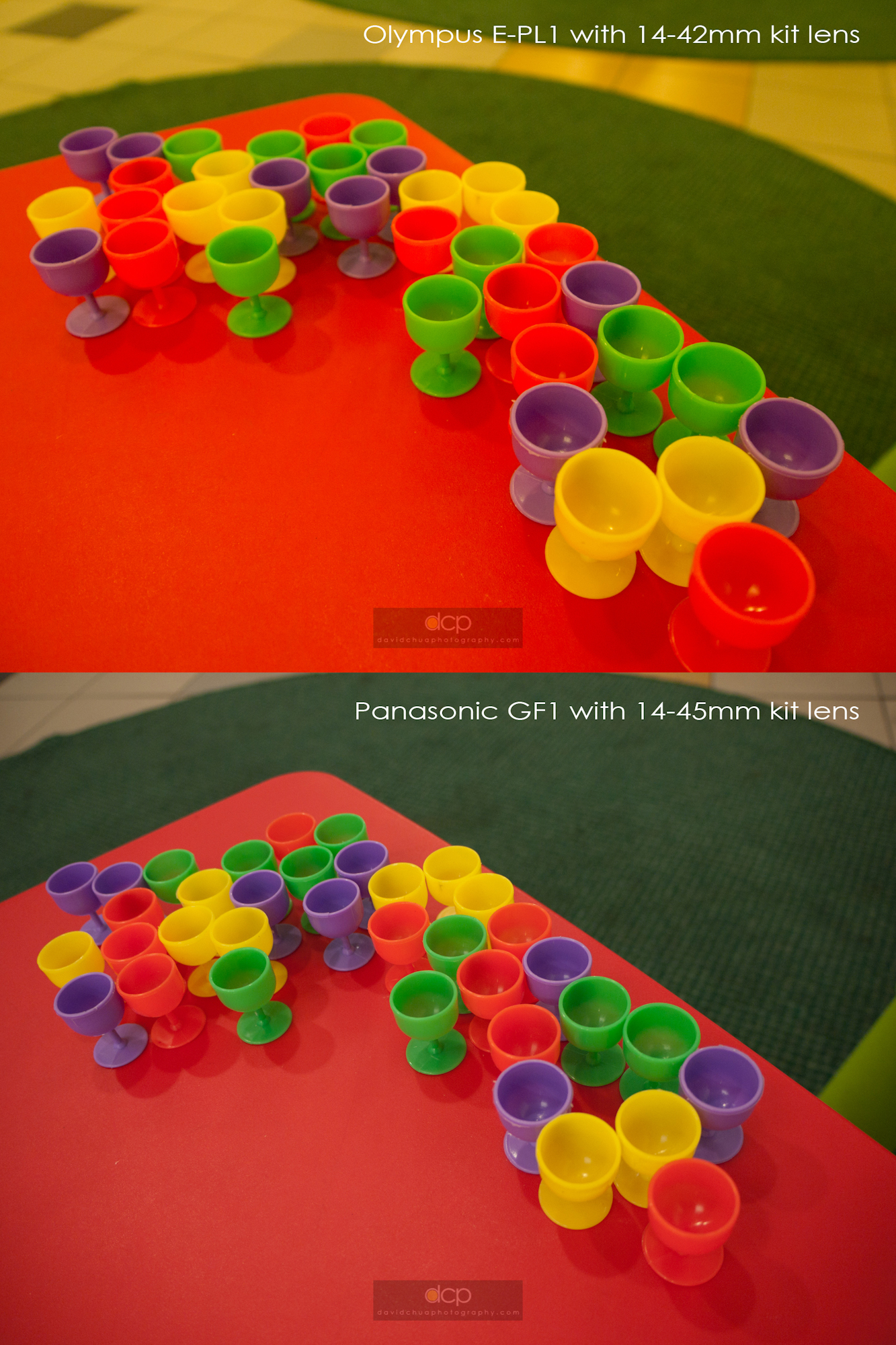
Finally, I have now got hold of the Panasonic GF1 with it’s Lumix 14-45mm kit lens (Thanks to my friend CW) and the latest Olympus PEN E-PL1 with it’s M-Zuiko digital 14-42mm kit lens! Now, this shall be a FAIR COMPARISON, as much as possible, as both are with their standard kit zoom lenses.
I am writing this review of comparison between the two cameras in the SIMPLEST manner I can think of, yet hopefully good enough for the layman, and even for one who has ZERO knowledge of cameras and photography, to make a clearer decision between the two, i.e. WHICH TO BUY?
NO REVIEWER IS 100% BALANCED. So, make your own conclusions!
We have to understand that both cameras’ main target audience are NOT the Professionals. The main target audience are consumers, ordinary students, daddies, mummies… and photo enthusiasts who want something small to carry with them daily… yet something that way surpasses the usual compact digital cameras’ standards in image quality and handling.
We have also seen the Micro-four-thirds cameras landing in the bag of professionals as a leisure camera, second camera or a backup camera, and some use it for work like myself, or Kirk Tuck.
BUT this review is aimed NOT at the professionals.
In this review, I shot with both cameras set to iAuto Mode. I used them in my everyday life. I shoot like an ordinary Daddy, like what every dad would want to photograph his child. I used both cameras NO DIFFERENT from any of you out there. So, the images I am gonna present here are NO GALLERY PRINTS. :p
My Workflow:
Shot with both cameras using RAW, iAuto Mode. I used them in Normal Circumstances as an ordinary guy in his everyday life, shooting in shopping centres, shooting his own kid, shooting at home and wherever he goes. All images are converted to JPGs using Lightroom Beta 3 version in default mode with no additional modification to the files at all, not even exposure, just to show you what comes out straight from the cameras.
WHY SHOOT in iAUTO MODE?
These Micro Four Thirds cameras are meant to produce amazing pictures straight off the camera without having to adjust much settings. If I want a camera to adjust it’s settings as a playtime, it would be the Nikon D700 or the Nikon D3s. There is at least 100 menu options in them to choose from. Now, at least in my personal philosophy, I expect the camera to meet or exceed my expectations at it’s so-called most intelligent “iAuto Mode”!
iAuto Mode is supposedly much better than P (Program)Mode, or in Cantonese as a joke, what we call the “PUN” Mode (basically means “idiot mode”). It’s supposed to be much more intelligent than the P Mode. Now let’s see how “intelligent” each camera behaves… … here we go… …
NOTE: All images are uploaded in the highest tolerable resolution online in this blog possible for you to download and pixel-peep. To do that, keep clicking on image till you can right click and save the high resolution file.
1. Indoor Artificial Lighting Condition – Shopping Centers (Most digital cameras suck at this)
Verdict:
Digital cameras have always got a problem with reds. There are very few digital cameras that can reproduce red accurately. As both shots were shot in iAuto Mode, white balance was AWB(auto). In this instance, Olympus over-cooked the reds and Panasonic produced more neutral colors.
2. Action Shots Indoors using iAuto Mode
Verdict:
In handling the cameras, immediately you will feel that GF1′s auto-focusing is faster and seems more decisive and definite. Initial impression is that the GF1 “found” focus and snapped the shutter much faster than the E-PL1. BUT upon scrutinizing both cameras’ files in my computer, I have found that the GF1 may have activated it’s shutter much faster and easier than the E-PL1 but to my disappointment, the hit rates are just as bad as the E-PL1! The number of “useable” images shot in iAuto mode for both cameras, chasing after running kids, are just about the same amount! We are talking about nailing the focus.
Suggested Solutions:
A. Buy a DSLR which performs well through ISO3200 and above like the latest Canon 550D which is good through ISO6400
OR
B. Use ISO1600 on either the E-PL1 or GF1 coupled with a fast lens like the Lumix 20mm F1.7. Shoot RAW and convert using Lightroom or Photoshop and you get lesser noise than direct JPGs straight out of camera.
3. Macro Test, using the minimum focus distance on each lens
Verdict:
It is quite clear that the E-PL1′s 14-42mm kit lens has a much closer focusing distance which gives higher magnification though it underexposed. But just a little exposure adjustment either in-camera when shooting or in your computer will bring it’s shine back easily!
4. i-Auto Intelligence in using In-Body Image Stabilization and Lens Optical Stabilization in lowlight conditions
Verdict:
It’s not fair to say that Olympus’s in-body I.S. is better than the Panasonic lens’s O.S. here as the iAuto mode in both cameras gave a drastic difference in ISO, which results in different shutter speeds.
But what we can see here, and from all the above examples so far is that Panasonic tends to give a lower ISO which results in slower shutter speeds. In this instance, the intelligence in the E-PL1 beats the GF1.
Panasonic should learn that it’s lens’s O.S. is not good enough for 1/8s in it’s iAuto Mode! Having this happened in iAuto Mode is quite unforgivable unless they are like the Nikon guys who expect us to dabble an hour or two with it’s menu before shooting. Unlike Olympus, I have done many shots with the E-P1 and E-P2 at shutter speeds as slow as 1/2s and achieved sharp images using it’s in-body image stabilization!
5. Daylight Photography
Now, by today’s digital photography technology standards, all cameras should already have no problems rendering DAYLIGHT images. Let’s see … …
Again, the reds are different here. Maybe it’s just “different film” we are looking at here? Which “film” do you prefer? Also, the iAuto on both cameras focused differently. But this can be done manually by “re-focusing” the camera (just let go of shutter button and press another few times till desired focus point is achieved or manually select focus point).
Digital cameras not just have a thing about the reds but also the purples. Both cameras rendered purple very differently. If we talk about reality, Olympus rendered purple as purple, much closer to the real colors. As for the Panasonic, morning glory has turned blue.
My boy wanted rain in such extremely hot season lately. Personally, I prefer the greens from the Olympus in these shots.
Next, we look at the ergonomics of both cameras.
Verdict:
1. Panasonic doesn’t seem to understand the power of Micro Four Thirds is in it’s SIZE too. The pursuit of producing High Quality Cameras in the smallest size possible. Even Ricoh understood that! (Beautiful GXR!) It’s either we settle down on the size of a typical DSLR or we go really small.
2. The collapsible Olympus kit lens is even lighter than the ones that came with the E-P1 and E-P2 this time, having a plastic mount. The front element when extended still is wiggly though it does not affect it’s function at all. If you want something real solid, go for the Leicas. :p
3. The grip on the E-PL1 feels much better and more comfortable than the GF1. The GF1 is a little heavy for it’s smooth grip.
4. The shutter sound on the E-PL1 sounds nicer to me. The GF1 sounds clanky.
5. Though the GF1 seems quicker in releasing it’s shutter, results have shown it does not necessarily means nailing the focus better than the E-PL1.
Overall, the GF1 looks more classy, expensive and professional and the E-PL1 looks more plasticky BUT I personally prefer the lightweight E-PL1 and it’s overall image performance. Again, if I want something real professional, classy and small, it will be either the Leica M8 or M9.
As compared with the E-P1 and E-P2, this is what I discovered:
1. The E-PL1 is much sharper than both E-P1 and E-P2.
2. The AF on the E-PL1 is slightly faster than the E-P1 and E-P2. The AF is exceptionally fast with the NEW m-zuiko 9-18mm lens. This one I hope I can get a copy for further review at a later stage but I tried it once and it was really impressive!
3. The E-PL1 is more intelligent in handling backlit situations. It is also overall more intelligent than the E-P1 and E-P2.
I hope I have not made people more confused and all the effort I put in this post helps someone out there.
Cheers!
Bookmark me, subscribe to my blog, comment or email me to make a friend. Stay tuned for more updates very soon!
Related Posts:


